An embedded control system designed to optimize the operation of air-conditioning units in telecom switch rooms.
The Challenge
Maintaining temperature without unnecessary energy consumption
Telecom switch rooms contain electronic equipment that operates continuously and generates significant heat. Maintaining the required room temperature is therefore essential for the reliable operation of switches, controllers and other electronic systems.
Air-conditioning was consequently a significant operating cost. The challenge was to maintain the required temperature while avoiding unnecessary operation of all four AC units and distributing the operating load across the available systems.
The Solution
Temperature-driven control of four AC units
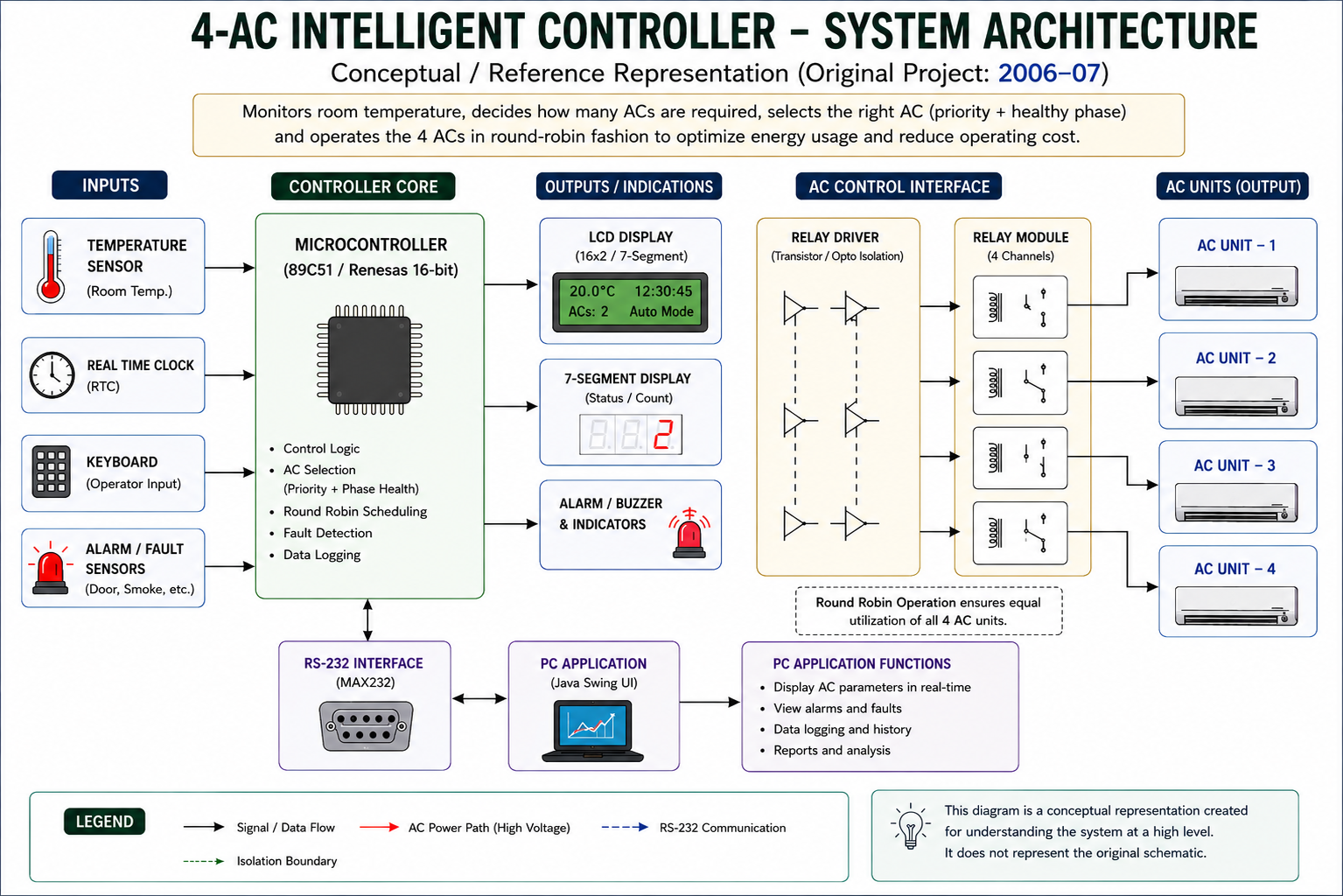
The 4-AC Controller continuously monitored room temperature and determined how many AC units were required to maintain the desired operating range.
When an AC needed to be started, the controller considered the configured priority and the availability of a healthy phase voltage before selecting the unit.
The four ACs were also operated in a round-robin sequence, distributing operating hours across the available units rather than continuously relying on the same AC.
The solution was initially developed around an 8-bit 89C51 microcontroller and was subsequently replicated on a Renesas 16-bit microcontroller platform.
How It Worked
System Architecture
The controller combined temperature sensing, embedded control logic, AC switching, monitoring and PC-based communication into a single control system.
Conceptual / Reference Representation — Original Project: 2006–07
Engineering Contribution
Across electronics, embedded software and PC integration
Electronics & Power
Designed electronics and power-supply circuitry.
Worked with 240V AC to low-voltage DC conversion.
Designed analog and digital circuits.
Implemented relay-based AC start/stop control.
Worked with electrical isolation between systems.
Embedded Software
Microcontroller programming in C.
LCD and 7-segment display programming.
Real-Time Clock interfacing.
Keyboard sensing and alarm monitoring.
Fault data logging.
Communication & PC Application
RS-232 serial communication between controller and PC.
Retrieved and displayed AC parameters.
Developed a Java Swing-based PC interface.
Engineering & Delivery
Testing and troubleshooting.
Technical documentation.
Support during deployment and sales activities.
Result
Optimizing AC operation
The controller enabled more optimum use of the four AC units by operating only the required number of units and distributing operating time across the available systems.
This helped reduce unnecessary air-conditioning energy consumption and operating costs in telecom switch-room environments.
The system was deployed in telecom environments including BSNL, Vodafone, IDEA and Bharti Telecom.
What I Learned
Connecting physical systems with technology
This project gave me hands-on experience across electronics, embedded systems and software. I contributed to the design of the power-supply circuit, relay-based AC control, microcontroller programming in C, LCD and memory interfacing, and electrical isolation between systems.
Coming from an earlier background in boiler inspection and energy auditing, I was already interested in identifying and reducing energy losses. The 4-AC Controller showed me how technology could be applied directly to an energy-efficiency problem.
It reinforced an idea that has stayed with me: careful observation of an engineering problem, combined with appropriate technology, can turn an operational inefficiency into an opportunity for improvement.